CMP Journal 2026-01-03
Statistics
Physical Review Letters: 12
Physical Review X: 2
Physical Review Letters
Faster Randomized Dynamical Decoupling
Article | Quantum Information, Science, and Technology | 2026-01-02 05:00 EST
Changhao Yi, Leeseok Kim, and Milad Marvian
We present a randomized dynamical decoupling (DD) protocol that can substantially improve the performance of any given deterministic DD scheme for suppressing coherent noise by using no more than two additional pulses. Our construction is implemented by probabilistically applying sequences of pulses…
Phys. Rev. Lett. 136, 010601 (2026)
Quantum Information, Science, and Technology
Positive Geometry for Stringy Scalar Amplitudes
Article | Particles and Fields | 2026-01-02 05:00 EST
Christoph Bartsch, Karol Kampf, David Podivín, and Jonah Stalknecht
We introduce a new positive geometry, the associahedral grid, which provides a geometric realization of the inverse string theory Kawai-Lewellen-Tye kernel. It captures the full dependence of stringified amplitudes for biadjoint scalar theory, pions in the nonlinear sigma model (NLSM), and the…
Phys. Rev. Lett. 136, 011601 (2026)
Particles and Fields
Simultaneous Probe of the Charm and Bottom Quark Yukawa Couplings Using $t\overline{t}H$ Events
Article | Particles and Fields | 2026-01-02 05:00 EST
A. Hayrapetyan et al. (CMS Collaboration)
A search for the standard model Higgs boson decaying to a charm quark-antiquark pair, , produced in association with a top quark-antiquark pair () is presented. The search is performed with data from proton-proton collisions at , corresponding to an integrated luminosity of
Phys. Rev. Lett. 136, 011801 (2026)
Particles and Fields
Turbulent Multiscale Interactions between Tearing Modes, Trapped-Electron Modes, and Zonal Flows
Article | Plasma and Solar Physics, Accelerators and Beams | 2026-01-02 05:00 EST
T. Jitsuk, M. J. Pueschel, P. W. Terry, and A. Di Siena
Interactions between MHD-scale tearing modes (TMs) and ion-gyroradius-scale trapped-electron modes (TEMs) in a fusion plasma are simulated with global gyrokinetics, using a consistent set of fixed equilibrium profiles. Unstable core TMs nonlinearly couple and transfer energy to smaller-scale stable …
Phys. Rev. Lett. 136, 015101 (2026)
Plasma and Solar Physics, Accelerators and Beams
Quantum Vortices Leave a Macroscopic Signature in the Thermal Background
Article | Condensed Matter and Materials | 2026-01-02 05:00 EST
Luca Galantucci, Giorgio Krstulovic, and Carlo F. Barenghi
Recent work has highlighted the remarkable properties of quantum turbulence in superfluid helium II, consisting of a disordered tangle of quantized vortex lines which interact with each other and reconnect when they collide. According to Landau's two-fluid theory, these vortex lines move in a surrou…
Phys. Rev. Lett. 136, 016001 (2026)
Condensed Matter and Materials
Common Sublattice-Pure Van Hove Singularities in the Kagome Superconductors $A{\mathrm{V}}{3}{\mathrm{Sb}}{5}$ ($A=\mathrm{K}$, Rb, Cs)
Article | Condensed Matter and Materials | 2026-01-02 05:00 EST
Yujie Lan, Yuhao Lei, Congcong Le, Brenden R. Ortiz, Nicholas C. Plumb, Milan Radovic, Xianxin Wu, Ming Shi, Stephen D. Wilson, and Yong Hu
Kagome materials offer a versatile platform for exploring correlated and topological quantum states, where Van Hove singularities (VHSs) play a pivotal role in driving electronic instabilities, exhibiting distinct behaviors depending on electron filling and interaction settings. In the recently disc…
Phys. Rev. Lett. 136, 016401 (2026)
Condensed Matter and Materials
Quantum Chemistry for Solids Made Simple on the Clifford Torus
Article | Condensed Matter and Materials | 2026-01-02 05:00 EST
Amer Alrakik, Gian Luigi Bendazzoli, Stefano Evangelisti, and J. Arjan Berger
We present a general theory to treat periodic solids with quantum-chemistry methods. It relies on two main developments: (1) the modeling of a solid as a Clifford torus, which is a torus that is both periodic and flat, and (2) the introduction of a periodic Gaussian basis set that is compatible with…
Phys. Rev. Lett. 136, 016402 (2026)
Condensed Matter and Materials
Stripe-Nematic Phase of Composite Fermions
Article | Condensed Matter and Materials | 2026-01-02 05:00 EST
Chengyu Wang, S. K. Singh, C. T. Tai, A. Gupta, L. N. Pfeiffer, K. W. Baldwin, and M. Shayegan
Electronic stripe-nematic phases are fascinating, strongly correlated states characterized by spontaneous rotational symmetry breaking. In the quantum Hall regime, such phases typically emerge at half-filled, high-orbital-index () Landau levels (LLs) where the short-range Coulomb interaction is s…
Phys. Rev. Lett. 136, 016501 (2026)
Condensed Matter and Materials
Orbital Inverse Faraday and Cotton-Mouton Effects in Hall Fluids
Article | Condensed Matter and Materials | 2026-01-02 05:00 EST
Gabriel Cardoso, Erlend Syljuåsen, and Alexander V. Balatsky
We report two light-induced orbital magnetization effects in quantum Hall (QH) fluids, stemming from their transverse response. The first is a purely transverse contribution to the inverse Faraday effect (IFE), where circularly polarized light induces a dc magnetization by stirring the charged fluid…
Phys. Rev. Lett. 136, 016502 (2026)
Condensed Matter and Materials
Half-Quantized Chiral Edge Current in a $C=1/2$ Parity Anomaly State
Article | Condensed Matter and Materials | 2026-01-02 05:00 EST
Deyi Zhuo, Bomin Zhang, Humian Zhou, Han Tay, Xiaoda Liu, Zhiyuan Xi, Chui-Zhen Chen, and Cui-Zu Chang
A single massive Dirac surface band is predicted to exhibit a half-quantized Hall conductance, a hallmark of the parity anomaly state in quantum field theory. Experimental signatures of the parity anomaly state have been observed in semimagnetic topological insulator (TI) bilayers, yet w…
Phys. Rev. Lett. 136, 016601 (2026)
Condensed Matter and Materials
Optical Signatures of Quantum Skyrmions
Article | Condensed Matter and Materials | 2026-01-02 05:00 EST
Sanchar Sharma and Christina Psaroudaki
Magnets have recently emerged as promising candidates for quantum computing, particularly using topologically-protected nanoscale spin textures. While the quantum dynamics of such spin textures has been theoretically studied, direct experimental evidence of their nonclassical behavior remains an ope…
Phys. Rev. Lett. 136, 016701 (2026)
Condensed Matter and Materials
Giant Reversible Piezoelectricity from Symmetry-Governed Stochastic Dipole Hopping
Article | Condensed Matter and Materials | 2026-01-02 05:00 EST
Denan Li, Haofei Ni, Yi Zhang, and Shi Liu
Organic-inorganic hybrid perovskites with giant piezoelectric responses, exemplified by , represent a promising platform for flexible and environmentally friendly electromechanical materials. However, the microscopic origin of such exceptional performance in this weakly polar system has re…
Phys. Rev. Lett. 136, 016801 (2026)
Condensed Matter and Materials
Physical Review X
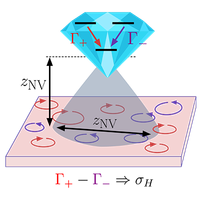
Nanoscale Defects as Probes of Time-Reversal Symmetry Breaking
Article | 2026-01-02 05:00 EST
Suman Jyoti De, T. Pereg-Barnea, and Kartiek Agarwal
A new technique using diamond NV centers detects time-reversal symmetry breaking in 2D materials by comparing spin relaxation due to opposite circular magnetic polarizations, enabling nanoscale probes of Hall conductivity and other chiral quantum effects.
Phys. Rev. X 16, 011001 (2026)
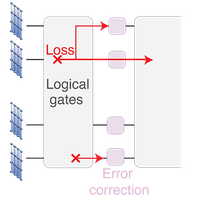
Leveraging Qubit Loss Detection in Fault-Tolerant Quantum Algorithms
Article | 2026-01-02 05:00 EST
Gefen Baranes, Madelyn Cain, J. Pablo Bonilla Ataides, Dolev Bluvstein, Josiah Sinclair, Vladan Vuletić, Hengyun Zhou, and Mikhail D. Lukin
Many quantum algorithms naturally detect and tolerate qubit loss. Combining them with a delayed-erasure decoding method that corrects missing qubits offers a simpler path toward scalable, fault-tolerant quantum computing.
Phys. Rev. X 16, 011002 (2026)